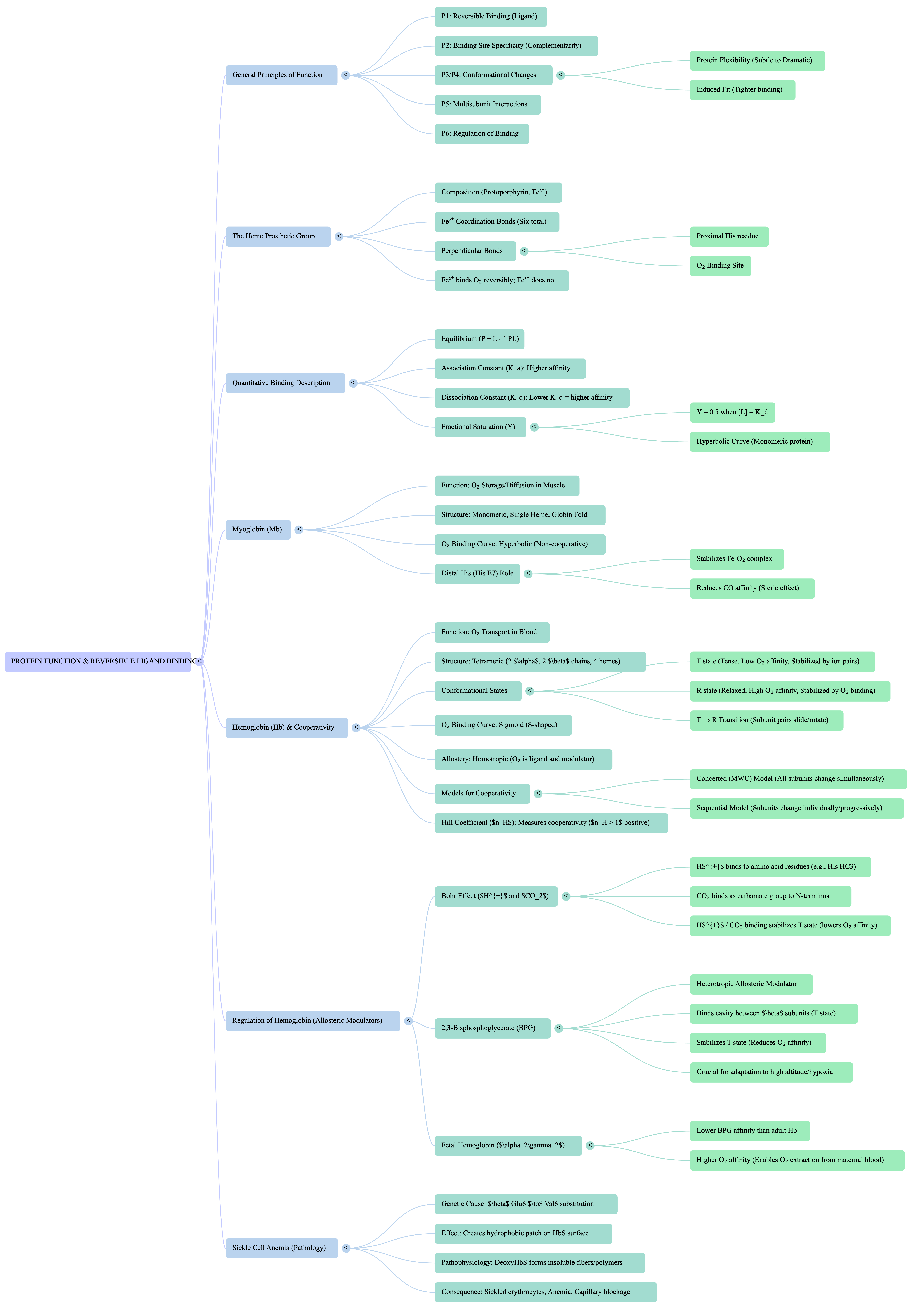
05 MYOGLOBIN/HEMOGLOBIN
05 Myoglobin & Hemoglobin
Executive Summary
The central theme of this chapter is that proteins carry out their biological functions through dynamic and reversible interactions with other molecules, known as ligands. While some interactions are catalytic, this chapter focuses on non-catalytic binding, where the ligand's chemical composition remains unchanged. Myoglobin (Mb) and Hemoglobin (Hb) serve as the primary case studies for these principles. Myoglobin, a simple monomeric protein found in muscle, functions as an efficient oxygen-storage unit. Its high, constant affinity for oxygen ensures a ready supply during periods of high demand.
In contrast, hemoglobin is a complex, multi-subunit protein responsible for transporting oxygen in the blood from the lungs to the tissues. Its sophisticated function is a direct result of allosteric regulation. Hemoglobin can exist in two different structural states: a low-affinity "tense" (T) state and a high-affinity "relaxed" (R) state. The binding of one oxygen molecule to a subunit in the T state triggers a conformational change that is communicated to the other subunits, causing the entire protein to shift towards the R state. This process, known as cooperative binding, allows hemoglobin to bind oxygen efficiently in the high-oxygen environment of the lungs and release it effectively in the low-oxygen environment of the tissues.
The function of hemoglobin is further fine-tuned by several key physiological regulators, including pH, carbon dioxide (CO₂), and 2,3-bisphosphoglycerate (BPG). These molecules act as allosteric modulators, decreasing hemoglobin's oxygen affinity to promote its release where it is most needed. The take-home message is that the detailed three-dimensional structures of myoglobin and hemoglobin are perfectly adapted to their specific physiological roles. Even minor alterations to this structure, as demonstrated by the single amino acid change in sickle cell anemia, can have profound and devastating consequences on health.
1. The Core Principles of Protein-Ligand Interactions
Before diving into the specific examples of myoglobin and hemoglobin, it is crucial to understand the fundamental rules that govern how all proteins interact with ligands. These principles are not unique to oxygen-binding proteins; they are the foundation for a vast array of complex biological processes, from immune responses to muscle contraction. Grasping these core concepts provides the framework for understanding nearly every aspect of protein function.
- Principle 1: Reversible Binding A protein's function often involves binding to a ligand—any molecule, including another protein, that it interacts with. This binding is transient and reversible, which is critical for allowing biological systems to respond rapidly and dynamically to changing metabolic and environmental signals.
- Principle 2: Specificity and Complementarity A ligand binds to a specific location on a protein called a binding site. This site is highly complementary to the ligand in its size, shape, charge, and hydrophobic character, allowing the protein to discriminate and selectively bind the correct molecule from a crowded cellular environment.
- Principle 3: Flexibility and Conformational Change Proteins are not rigid, static structures. They are flexible and can undergo conformational changes, from subtle molecular vibrations to large-scale movements of entire domains, which are often essential for their function.
- Principle 4: Induced Fit The process of ligand binding often causes a conformational change in the protein that results in a tighter, more complementary fit. This structural adaptation between the protein and its ligand is known as "induced fit" and is a key mechanism for achieving high binding affinity.
- Principle 5: Subunit Communication in Multimeric Proteins In proteins composed of multiple polypeptide chains (subunits), a conformational change in one subunit can influence the shape and function of the other subunits. This inter-subunit communication is the basis for cooperative and allosteric regulation.
- Principle 6: Regulation of Binding The interaction between a protein and its ligand is not always constant. It can be regulated, meaning its affinity can be modulated (increased or decreased) by other factors or molecules, allowing for fine-tuned control over biological processes.
With this foundational toolkit in hand, let's now see these principles in action by examining the vital function of transporting oxygen throughout the body.
2. The Challenge of Oxygen Transport and the Heme Solution
For large, multicellular organisms to survive, oxygen must be efficiently transported from the environment to the tissues to fuel cellular respiration. However, this presents a physiological problem: oxygen is poorly soluble in aqueous solutions like blood, and its diffusion is ineffective over distances greater than a few millimeters. Furthermore, none of the standard amino acid side chains are capable of reversibly binding oxygen. Nature’s solution to this challenge is to utilize a specialized prosthetic group that incorporates a transition metal.
The solution is the heme prosthetic group, a compound permanently associated with oxygen-binding proteins. Its structure is perfectly suited for this role:
- Core Structure: Heme consists of a complex organic ring called protoporphyrin.
- Central Atom: At the center of this ring is a single iron atom in its ferrous (Fe²⁺) state. This oxidation state is essential, as only Fe²⁺ can bind oxygen reversibly; the oxidized ferric (Fe³⁺) state cannot.
- Coordination Bonds: The central iron atom can form six coordination bonds. Four of these bonds are within the plane of the protoporphyrin ring, linking the iron to nitrogen atoms. The remaining two bonds are perpendicular to the ring.
The protein environment is critical for heme to function correctly. One of the two perpendicular coordination bonds is occupied by a nitrogen atom from the side chain of a proximal His residue belonging to the protein. The other perpendicular bond is the binding site for molecular oxygen (O₂). The coordinated nitrogen atoms of the porphyrin ring have an electron-donating character that helps prevent the conversion of the heme iron to the Fe³⁺ state. By sequestering the heme group deep within its structure, the protein provides an additional layer of protection, preventing the irreversible oxidation of Fe²⁺ to Fe³⁺, which would render the heme useless for oxygen transport. We will first examine these features in myoglobin, a relatively simple heme-containing protein.
3. Myoglobin (Mb): A Case Study in Simple Ligand Binding
Myoglobin (Mb) serves as an excellent model for understanding simple, non-cooperative ligand binding. As a monomeric protein found in high concentrations in muscle tissue, its primary physiological function is the storage of oxygen, providing a reserve for muscles during periods of intense activity. Its structure and binding properties are perfectly tailored for this role.
Key Structural Features of Myoglobin:
- Structure: Myoglobin is a single, compact polypeptide chain of 153 amino acids containing one heme prosthetic group.
- Fold: The polypeptide is arranged into eight α-helices (labeled A through H), forming a conserved structural motif known as the "globin fold."
Quantitative Description of Oxygen Binding: The reversible binding of a ligand (L) to a protein (P) can be described by a simple equilibrium: P + L ⇌ PL. This interaction is quantified by the dissociation constant (Kd), which is defined as the ligand concentration at which half of the protein's binding sites are occupied. A key takeaway for students is that a lower Kd value signifies a higher affinity between the protein and its ligand.
- The oxygen-binding curve for myoglobin has the shape of a rectangular hyperbola. This shape is characteristic of simple, independent binding; each oxygen molecule binds to a myoglobin molecule without influencing any others.
- For a gaseous ligand like oxygen, its concentration is expressed as a partial pressure (pO₂), and the Kd is referred to as P₅₀. Myoglobin has a very low P₅₀ of 0.26 kPa, indicating its extremely high affinity for oxygen. This makes it an ideal storage protein; it binds oxygen tightly at the pO₂ of resting muscle and only releases it when the local pO₂ drops dramatically during intense exercise, which is exactly the behavior required of an emergency reserve tank.
The Role of the Distal His (His E7): The protein environment actively influences ligand binding. For free heme, carbon monoxide (CO) binds >20,000 times better than O₂. In myoglobin, this dangerous preference is reduced to only about 40 times better, thanks to the distal His (His E7). This residue is located near the heme but does not directly bond to the iron. It serves two critical functions:
- It forms a hydrogen bond with the bound O₂ molecule. This selectively stabilizes the O₂-heme complex, increasing the affinity for oxygen relative to other molecules like carbon monoxide.
- It acts as a physical "gate," with its side chain rotating to control the entry and exit of oxygen from the heme binding pocket.
While myoglobin's simple binding is perfect for storage, a more complex and regulated mechanism is required for an effective oxygen transport protein, which leads us to hemoglobin.
4. Hemoglobin (Hb): A Masterclass in Allosteric Regulation
Hemoglobin (Hb) is the sophisticated, multi-subunit protein responsible for transporting oxygen from the lungs to the peripheral tissues via the blood. Its function is fundamentally different from myoglobin's: it must not only bind oxygen tightly where it is abundant (the lungs) but also release it easily where it is scarce (the tissues). This complex behavior is achieved through its quaternary structure and its remarkable properties as an allosteric protein.
Structure of Hemoglobin:
- Quaternary Structure:
- Composition: Hemoglobin is a tetramer, composed of four polypeptide chains and four heme groups.
- Adult Hemoglobin (HbA): The most common form in adults consists of two identical α chains (141 residues) and two identical β chains (146 residues), forming an α₂β₂ structure.
- Heme Groups: Each of the four subunits contains one heme group, allowing a single hemoglobin molecule to bind up to four molecules of O₂.
The Two Conformational States of Hemoglobin: Hemoglobin can exist in two major conformations, which differ in their affinity for oxygen. The transition between these states is the key to its function.
|
Feature |
T (Tense) State |
R (Relaxed) State |
|
Oxygen Affinity |
Low |
High |
|
Stability |
More stable in the absence of O₂ |
Stabilized by O₂ binding |
|
Defining Feature |
Stabilized by a greater number of ion pairs (salt bridges) between subunits. |
Fewer ion pairs, more flexible structure. |
Cooperative Binding: The hallmark of hemoglobin's function is positive cooperativity, which is visually represented by its sigmoid (S-shaped) oxygen-binding curve. This behavior is a direct manifestation of Principle #5: Subunit Communication.
- This S-shape signifies that the binding of oxygen to one subunit increases the oxygen affinity of the remaining subunits. The first O₂ molecule binds with difficulty to a subunit in the low-affinity T state. However, this binding event triggers a conformational change that is communicated across the subunit interfaces—the physical mechanism of subunit communication—causing the entire tetramer to shift towards the high-affinity R state. Think of it like a row of four interconnected switches; flipping the first one (binding O₂) makes it mechanically easier to flip the next three.
- So what? This cooperative mechanism makes hemoglobin an exceptionally efficient oxygen transporter. It becomes nearly saturated with oxygen in the lungs (high pO₂) but readily unloads a significant portion of that oxygen in the tissues (low pO₂), responding sensitively to the small difference in partial pressure between these two locations.
Allostery and Cooperativity Models:
- An allosteric protein is one in which the binding of a ligand at one site affects the binding properties of a different site on the same protein. For hemoglobin, oxygen acts as a homotropic activator, as it is both the ligand and the molecule that enhances its own binding.
- Two classic models describe this cooperative behavior. The MWC (concerted) model proposes an "all-or-none" transition where all four subunits are in the same state (either all T or all R) at any given time. The Sequential model is more flexible, allowing for intermediate states where some subunits have changed conformation while others have not.
Hemoglobin's function is not solely dependent on oxygen concentration; it is further fine-tuned by the binding of other molecules present in the blood.
5. Physiological Regulation of Hemoglobin's Affinity
Hemoglobin's affinity for oxygen is not fixed but is dynamically modulated by several factors in the blood, ensuring that oxygen delivery is matched to metabolic needs. These regulatory molecules are examples of heterotropic allosteric modulation, where molecules other than oxygen bind to the protein and influence its function. For example, hemoglobin transports 15% to 20% of the CO₂ formed in tissues, and its binding is regulated by the enzyme carbonic anhydrase, which is abundant in red blood cells and hydrates CO₂ to bicarbonate and H⁺.
The Bohr Effect (Regulation by H⁺ and CO₂): The Bohr effect describes the inverse relationship between the binding of O₂ and the binding of protons (H⁺) and carbon dioxide (CO₂). This effect is crucial for linking oxygen release to metabolic activity.
- In Tissues: Cellular respiration produces H⁺ (lower pH) and CO₂. Both stabilize the low-affinity T state, promoting oxygen release where it's most needed. The "how" is elegant: H⁺ protonates key residues like His HC3 of the β subunits, allowing it to form an ion pair with Asp FG1 that stabilizes the T state. Meanwhile, CO₂ binds to the amino-terminal α-amino groups of the globin chains, forming carbamates. These negatively charged groups create new salt bridges that also stabilize the T state.
- In Lungs: In the lungs, CO₂ is exhaled, and the concentration of H⁺ decreases (pH rises). This change destabilizes the T state and favors a transition to the high-affinity R state, which efficiently promotes the uptake of oxygen.
The Role of 2,3-Bisphosphoglycerate (BPG): 2,3-Bisphosphoglycerate is a small, highly negative molecule present in red blood cells that acts as a potent heterotropic allosteric inhibitor of oxygen binding.
- Mechanism: BPG binds to the central cavity of hemoglobin, but only when it is in the T state. Its binding further stabilizes the T state, significantly decreasing hemoglobin's affinity for oxygen. Without BPG, hemoglobin would bind oxygen so tightly that it would fail to release it effectively in the tissues.
- Physiological Importance (High Altitude Adaptation): When a person moves to a high altitude, the body increases the concentration of BPG in red blood cells. This rise in BPG lowers hemoglobin's O₂ affinity, causing it to release a larger percentage of its bound oxygen to the tissues, thereby compensating for the lower atmospheric pO₂.
Fetal Hemoglobin (HbF): The regulation of oxygen binding is also adapted for fetal development.
- Fetal hemoglobin (HbF) has a different quaternary structure (α₂γ₂) than adult hemoglobin (HbA, α₂β₂).
- Crucially, HbF has a much lower affinity for BPG than HbA does.
- Functional Consequence: Because it binds BPG less effectively, HbF has a significantly higher affinity for oxygen than the mother's HbA. This affinity difference creates the necessary gradient to ensure the efficient transfer of oxygen from the mother's blood, across the placenta, to the developing fetus.
These elegant regulatory mechanisms highlight how precisely hemoglobin is tuned for its role, and deviations from this structure can lead to severe medical consequences.
6. Clinical Correlations: When Hemoglobin Goes Wrong
The study of hemoglobin provides a powerful illustration of how a protein's precise molecular structure is inextricably linked to health and disease. When this structure is compromised, either by external molecules or genetic defects, the consequences can be life-threatening. Carbon monoxide poisoning and sickle cell anemia are two classic examples of this fundamental principle.
The Mechanism of Carbon Monoxide (CO) Poisoning: Carbon monoxide is a colorless, odorless gas that is highly toxic because of its interaction with hemoglobin.
- CO binds to the same heme iron site as oxygen but with an affinity that is approximately 250 times greater.
- This leads to a dual toxic effect:
- CO directly outcompetes O₂ for binding sites, drastically reducing the total oxygen-carrying capacity of the blood.
- When CO binds to one or more of the four subunits in a hemoglobin molecule, it allosterically locks the remaining subunits in the high-affinity R state. This prevents the hemoglobin molecule from releasing the little oxygen it is carrying to the tissues, leading to severe tissue hypoxia. As shown in Figure 2 of Box 5-1 in the source text, the binding curve for blood with 50% carboxyhemoglobin (COHb) is not just lower, but also shifted dramatically left into a hyperbolic shape, visually demonstrating that the remaining sites hold onto O₂ too tightly for release.
Sickle Cell Anemia as a Molecular Disease: Sickle cell anemia is a genetic disorder that results from a seemingly minor change in the hemoglobin protein.
- The Molecular Defect: The disease is caused by a single amino acid substitution in the β chain of hemoglobin. A negatively charged glutamate residue is replaced by a nonpolar valine at position 6 (Glu6Val).
- Consequence of the Mutation: This single change creates a "sticky" hydrophobic patch on the surface of the hemoglobin molecule, but importantly, this patch is exposed only when the hemoglobin is in the deoxygenated (T) state.
- Pathophysiology: This hydrophobic patch causes deoxygenated sickle cell hemoglobin (HbS) molecules to aggregate into long, rigid, insoluble fibers. These fibers grow and distort the normally flexible, biconcave red blood cells into a characteristic "sickle" shape.
- Clinical Results:
- Anemia: The fragile, sickled cells are recognized as abnormal and are destroyed by the body much more rapidly than healthy cells, leading to chronic anemia.
- Capillary Occlusion: The rigid, misshapen cells are unable to pass through small capillaries. They become lodged, blocking blood flow and causing episodes of extreme pain, organ damage, and stroke.
The elegant structure and complex regulation of hemoglobin, which allow it to sustain life by transporting oxygen, also make it a poignant example of the molecular basis of disease, cementing its status as a cornerstone of biochemical understanding.
Resources
- MIND_MAP
- FLASHCARDS
- SELF-ASSESSMENT
- PRESENTATION_SLIDES